Home space Scientists space Media space New Visitors
Home arrow News/Media arrow Press Releases arrow JR En Route to Bering Sea Climate Change Investigations
JR En Route to Bering Sea Climate Change Investigations Print E-mail
Welcomes Students Aboard in Victoria

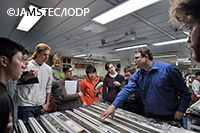
Washington, DC—The JOIDES Resolution, the U.S.-supported, newly equipped and modernized scientific ocean drilling vessel, is docked in the port of Victoria, British Columbia as it readies to embark on a nine-week international marine research expedition to investigate the role of the Bering Sea in climate change. While in port, approximately 100 undergraduate oceanography students from both the University of Victoria and Royal Roads University  prospective future participants in the Integrated Ocean Drilling Program (IODP) 
– will come aboard the research vessel to inspect new laboratories, see how scientists work in the field, and learn the inner workings of an actual research drillship. IODP Expedition 323, Bering Sea Paleoceanography, mobilizing in Victoria, is led by co-chief scientists Christina Ravelo of University of California, Santa Cruz, and Kozo Takahashi of Kyushu University, Japan. Canadian researcher Taoufik Radi, a paleontologist and professor at University of Quebec, Montreal, represents Canada’s marine research interests among the international group of research scientists.

 IODP Expedition 323 aims to extend the research findings of the 2004 IODP Arctic Coring Expedition (ACEX 302), which drilled and collected sediment samples from the Lomonosov Ridge in the central Arctic Ocean. Since that investigation’s conclusion, the scientific community has anticipated acquisition of new geological cores and data that address the age and effects of the Bering Strait gateway to the Arctic.

 “The Bering Sea drilling plan,” explains co-chief Christina Ravelo, “is essential to our ability to decipher the history of the Bering Strait gateway and determine its impact on global and regional climatic and oceanic processes. New cores will help us understand the exchange of heat and chemical elements running through the Bering Strait, and how those may have influenced Arctic and North Pacific environments. It also will help us understand how sea ice accelerates climate change, and how subpolar ecosystems respond to climate change,” she explains.

 The drilling plan prioritizes eight primary targets in the Bering Sea:


clip_image002.gif


(Table 1; Fig. 1). Planned drilling will allow penetration through sediments that scientists suspect date back through geological time to the Pliocene and possibly upper Miocene periods (approximately five million years ago). The drilling strategy is intended to help scientists capture important processes in the Bering Sea, including reconstruction of records related to sea-ice distribution and gradients.

Following an extensive modernization, the JOIDES Resolution returned to IODP operations in March 2009. Its first research investigation, the Pacific Equatorial Age Transect, was completed just prior to the ship’s arrival in Victoria. The scientific interactions of 50 scientists on board the vessel from March to June are expected to make a substantial contribution to the knowledge of Cenozoic ocean history and global climate change.

 The JOIDES Resolution is operated for IODP by the U.S. Implementing Organization (USIO) comprised of Texas A&M University, Lamont-Doherty Earth Observatory of Columbia University, and the Consortium for Ocean Leadership.

IODP is supported by two lead agencies: the U.S. National Science Foundation and Japan’s Ministry of Education, Culture, Sports, Science, and Technology. Additional program support comes from the European Consortium for Ocean Research Drilling (ECORD, of which Canada is a member country), India’s Ministry of Earth Science, the People’s Republic of China (Ministry of Science and Technology), the Republic of Korea (Korea Institute of Geoscience and Mineral Resources), Australia and New Zealand (Australian–New Zealand IODP Consortium). IODP’s principal areas of research are climate and environmental change, solid Earth processes, and the deep biosphere.


Contacts:

Gregg Schmidt
Consortium for Ocean Leadership

Cheryl Dybas
National Science Foundation

Nancy Light
IODP Management International
, +1-202-465-7511